
Selection Stories
An event in itself feels like a celebration of life. From a distance, it looks glamorous — beautiful flowers, perfect decorations, and an impressive stage that seems effortlessly put together.
But behind the scenes, the reality is completely different. It’s fast-paced, unpredictable, and often chaotic.
To understand this contrast, today we are talking to an event management student who has closely experienced the ground reality. Raghuveer, a student who has already attended and worked on multiple events and is close to completing his first year, shares his honest perspective.
Let’s see what real insights and reality checks this conversation brings.
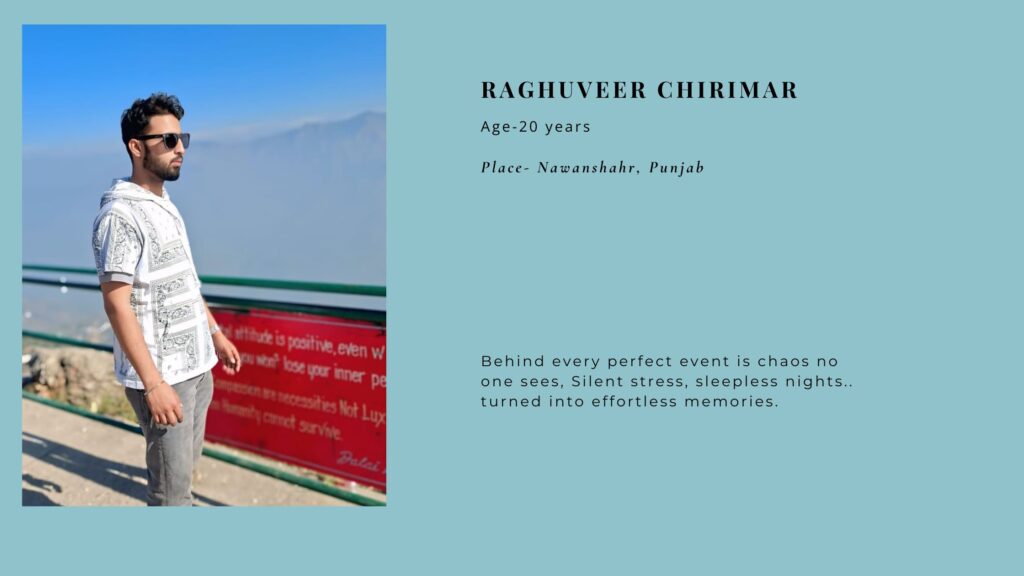
Q1) What made you choose event management as a career?
Raghuveer: After completing my 12th grade, I noticed that the event management industry was growing rapidly. It also shares some similarities with hotel management, but what makes it different is the high level of on-the-spot execution involved.
Event management requires quick decision-making, practical knowledge, and the ability to handle unexpected situations in real time. That dynamic nature really attracted me.
Another interesting aspect is that, because of its unpredictable and human-driven nature, it’s quite difficult for AI to fully replace this field. Considering all these factors, I decided to pursue event management.
Q2) How different is the reality of event management from what you initially expected?
Raghuveer: People often imagine events as a well-decorated, glamorous space where you simply walk around and enjoy the vibe. But the reality is quite the opposite — you are the one who builds that world from scratch. From the smallest details to the biggest setups, nothing comes ready-made.
Initially, I also thought that I would be the main decision-maker, shaping the event creatively. And yes, that idea feels exciting. But in reality, most decisions are driven by the client. Whether you personally agree or not, you have to align with their vision. Creativity exists, but applying it freely can be challenging.
Another big difference is timing. I knew the hours would be irregular, but the reality is even more extreme. You have to be present before the event starts and stay long after it ends. There’s no fixed schedule for food or rest — it’s all part of the process.
Q3) Do you think college teaches more, or does real-world experience shape you better?
Raghuveer: I believe around 70% of what we learn comes from practical, real-world experience, while 30% comes from academic study.
That said, theoretical knowledge is still important. It gives you a basic understanding of the field and helps you make fewer mistakes when you step into the real world.
But if you want to grow and sustain yourself in this industry for the long term, ground-level experience becomes essential. It teaches you things that no classroom ever can — especially in a field like event management, where every situation is different.
Q4) What is the reality of income and earning in event management?
Raghuveer: In this field, income is directly linked to the amount of work you do — more work usually means more money.
However, it’s not consistent throughout the year. There are slow seasons where work is limited, but during peak times like festivals and wedding seasons, you can earn really well if you’re actively working.
The earning potential is good, but it comes with a trade-off. You have to be ready to work long hours, put in a lot of effort, and sacrifice comfort. It’s simple — the more मेहनत (hard work) you put in, the more you can earn.
Q5) How has working in this field changed you as a person?
Raghuveer: In event management, no two events are ever the same. Even if you try to replicate everything, each event turns out differently.
Because of that, every event teaches you something new — whether it’s handling unexpected situations or understanding different types of people and their behavior.
Over time, I’ve noticed a lot of personal growth. I’ve become more adaptable, more patient, and better at dealing with real-life challenges. This field constantly pushes you to learn, and that’s something that has changed me a lot as a person.
Q6) What advice would you give to someone who wants to enter this field?
Raghuveer: This field shows you reality — not just about other people, but about yourself as well. So the first thing is to be mentally prepared for that.
Secondly, you have to accept that there’s no fixed routine here. From sleeping to eating, nothing follows a regular schedule. You need to be flexible and ready to adapt at any time.
If you’re willing to work hard, stay patient, and handle unpredictability, this field can teach you a lot and give you meaningful growth.
Q7) How much water do you consciously drink every day?
Raghuveer: 3–4 liters.
Q8) If you had the chance to meet God, what would you say?
Raghuveer: I would ask for all boundaries to disappear — not just between countries, but also between people.
I would wish for a world where weapons no longer exist, and where humanity stands united beyond differences.
A place where we don’t divide ourselves, but learn to live together with understanding and peace.
Q9) What does success mean to you?
Raghuveer: For me, success is not just about personal achievements. It’s about doing something meaningful for humanity.
I want to create an impact in a way that, even after I’m gone, people remember me through my work and the value I added to others’ lives.
That’s the kind of success that truly matters to me.
Q10) Is event management only for people from wealthy backgrounds?
Raghuveer: No, it’s not limited to people from wealthy backgrounds. This field is open to anyone who is willing to learn and put in the effort.
In fact, a lot of learning here is self-driven — no one can teach you everything. You grow through real experiences, challenges, and on-ground work.
That said, people from financially strong backgrounds might have certain advantages, especially when it comes to starting their own business or accessing resources. But in terms of learning and growth, the opportunities are the same for everyone.
At the end of the day, it depends more on your मेहनत (effort) and mindset than your background.
Q11) What financial advice would you give to someone starting out?
Raghuveer: The first step is to build an emergency fund. Try to save at least one month’s income and keep it aside in a bank for unexpected situations. This should always come first.
After that, you can divide your income smartly. Around 70% can go into investments — out of which 50% should be for long-term goals and 20% for short-term opportunities.
Keep 20% of your income for enjoyment and personal expenses, because balance is important. The remaining 10% can be saved additionally to strengthen your financial security over time.
The idea is simple — secure yourself first, invest wisely, and still allow yourself to enjoy the present.
———–Thank You———